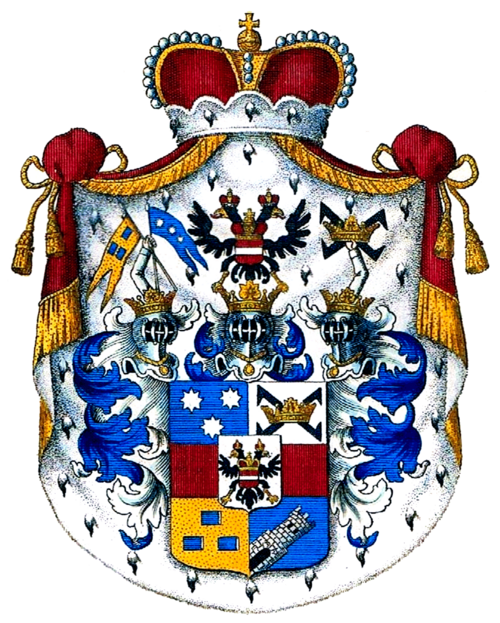




The Clary-Aldringen family ranks among the most important noble families associated with the history of Teplice and the entire region. Its origins lie in two ancient family lines – the Aldringen family from Lorraine and the Clary family, whose roots reach back to Tuscany.
When the Aldringen family died out in the male line in 1664, Johann Georg Markus Clary inherited not only the property of his mother, the last noblewoman of the Aldringen family, but also the estates of her brothers. With imperial consent, he united the name and coat of arms of both families and adopted the name Clary-Aldringen. He was also elevated to the rank of count, and among the extensive estates he inherited were Teplice.
The most prominent member of the family was undoubtedly Prince Edmund Clary-Aldringen, who took over the administration of the family estates at the age of just nineteen. He married Countess Elisalex Ficquelmont, for whom he had a romantic island built in the castle park, which remains a lasting reminder of him to this day. Edmund was educated, wise and politically liberal. He abolished forced labour on his estates even before it was required by law and played a key role in modernising the spa facilities. To continue developing Teplice, he even sold other family estates.
The Clary-Aldringen family managed the Teplice estate for almost fifty years after Edmund’s death. Their presence in Bohemia ended definitively in 1945, when they were forced to leave the country. Today, descendants of the family live mainly in Germany, yet Teplice has witnessed several symbolic returns and visits, reminding visitors of the deep historical bond between the family and the town.
The Clary-Aldringen family bore responsibility for administering an extensive estate and for the development of the spa town. Their rule was marked not only by success but also by severe trials, including the great town fire. Despite these challenges, the family succeeded in systematically improving Teplice and the surrounding landscape and in supporting the development of spa life, the economy and culture.